
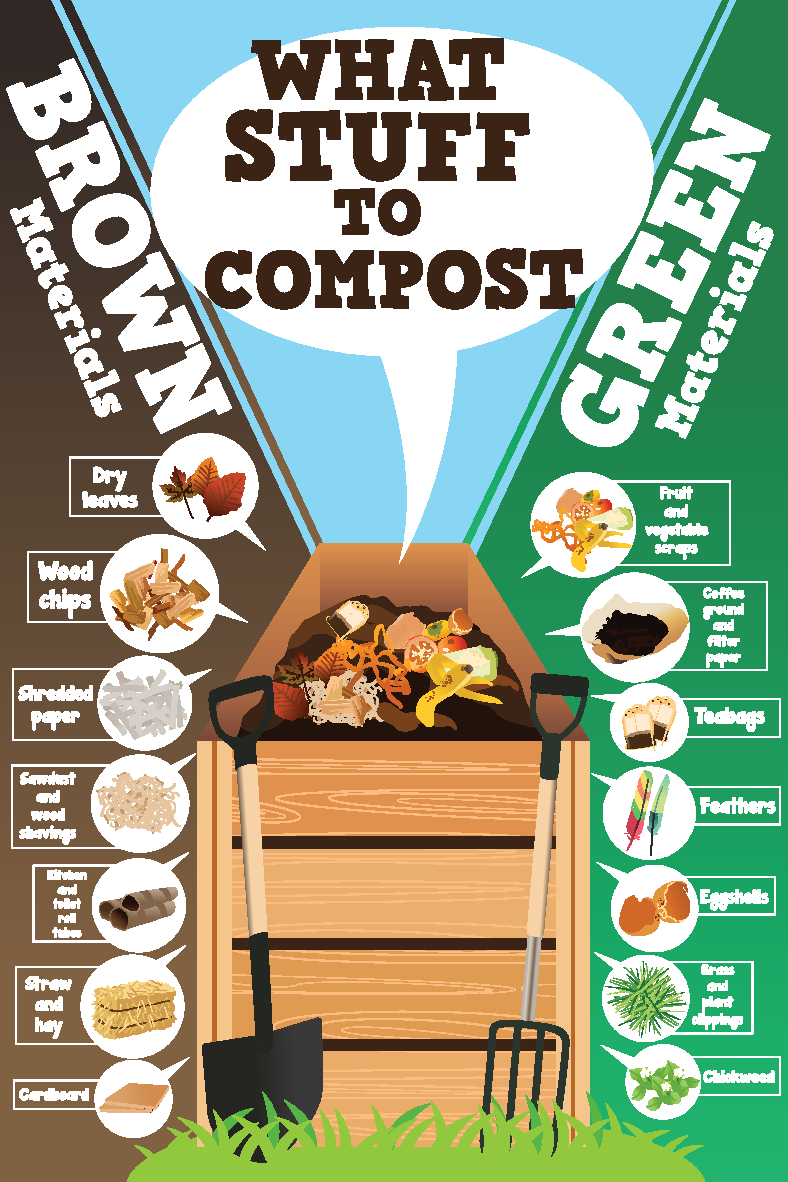
The easiest way to think about backyard composting is: greens provide wetter, nitrogen-rich material, while browns provide drier, carbon-rich material and structure.
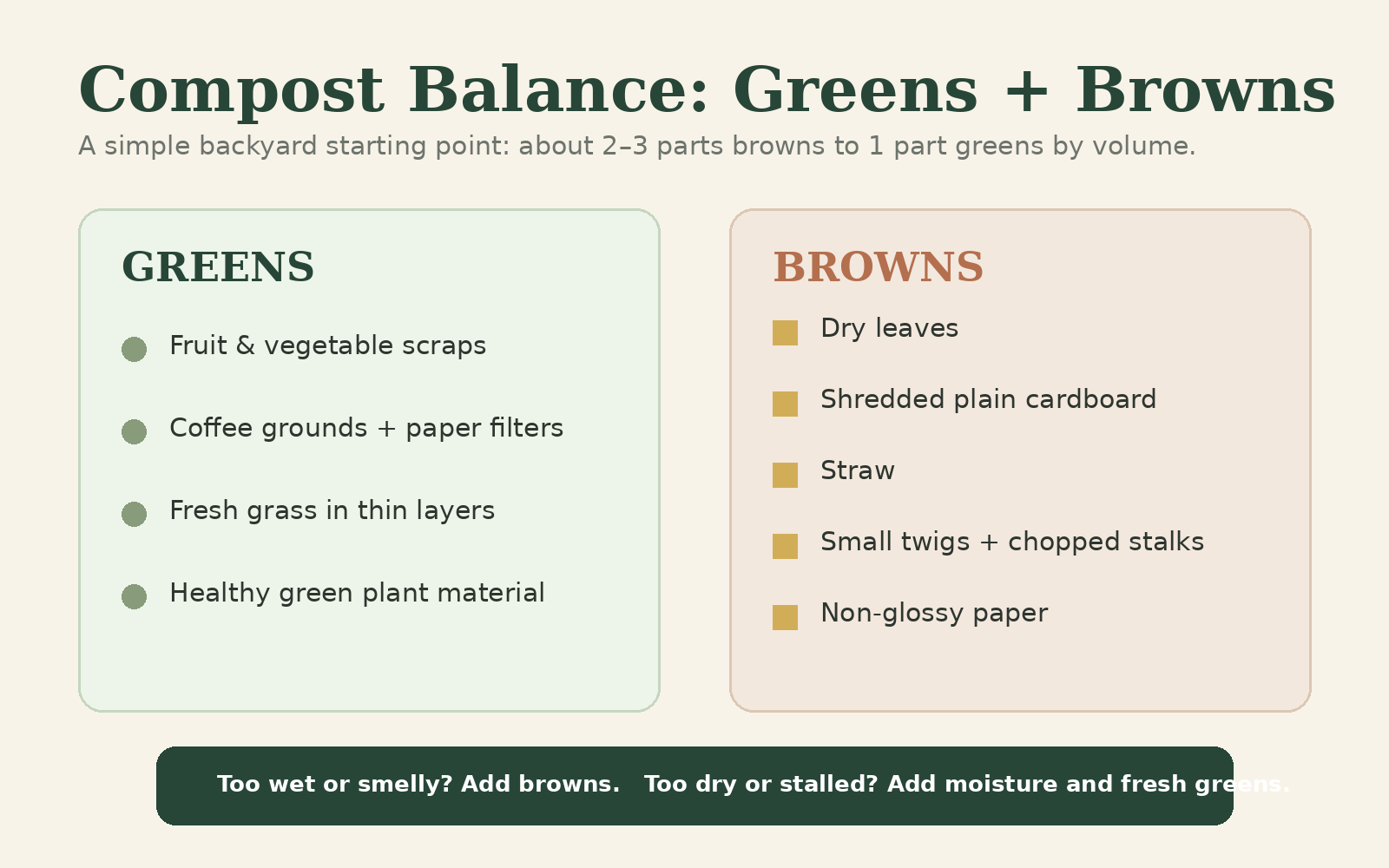
Greens
- Fruit and vegetable scraps
- Coffee grounds and paper filters
- Fresh grass clippings in reasonable amounts
- Healthy green plant material
Browns
- Dry leaves
- Small twigs and chopped stalks
- Shredded plain cardboard
- Non-glossy paper and brown paper bags
- Straw
A practical balance
A workable home-compost starting point is roughly two to three parts browns for every one part greens by volume. You do not need to measure perfectly. If you add wet kitchen scraps, cover them generously with dry material.
What should stay out?
- Meat, fish, bones, dairy, fats, oils, and grease
- Dog and cat waste or litter
- Diseased or badly pest-infested plants
- Weeds loaded with mature seed
- Painted, treated, or chemically contaminated wood
- Plastic and coated materials that are not actually home-compostable
Moisture and air
A compost pile should feel roughly like a wrung-out sponge: damp throughout but not dripping. It also needs oxygen. Turn or fluff compacted material occasionally and use browns to keep the pile from becoming a wet, airless mass.
When is compost finished?
Finished compost is dark, loose, crumbly, and smells earthy. You should not be able to identify most of the original scraps.
If your pile smells bad, attracts pests, refuses to break down, or is too wet or too dry, I moved those fixes into a separate troubleshooting guide instead of making this article twice as long.
Layering is helpful, but mixing matters more
You will often see compost described as neat alternating layers of greens and browns. That can be a useful way to begin a pile, but decomposition speeds up when different materials actually touch each other. Mix wet kitchen scraps with drier leaves or shredded cardboard instead of building one thick layer of each. Smaller pieces break down faster, but there is no need to turn every ingredient into confetti. A mix of particle sizes also helps create air spaces in the pile.
Compost changes with the seasons
In summer, a pile may dry faster than expected and need occasional water. During wet periods, the challenge can be too much moisture, especially in a closed bin. Fall leaves are valuable because they give you a large supply of browns that can be stored and used throughout the year. A simple bag or bin of dry leaves near the compost area makes it much easier to cover kitchen scraps immediately rather than hunting for carbon material later.
How to use finished compost
Finished compost can be spread over garden beds, mixed lightly into the upper soil before planting, or used as a top-dressing around established plants. It is a soil amendment, not a concentrated fertilizer, so its biggest value is improving soil structure, water-holding behavior, and biological activity while returning organic matter to the garden. In heavy North Texas clay, repeated modest additions are generally more useful than one huge application.
Keep the system simple enough to continue
The best compost method is one you will actually maintain. A perfect hot pile that requires constant measuring and turning is not necessary for every household. If your system consistently keeps food waste out of the trash, avoids odors and pests, and eventually produces dark, earthy material, it is doing its job.
What composting can and cannot do
Compost improves soil, but it does not automatically correct every nutrient imbalance, drainage problem, or pH issue. Think of it as one part of a larger soil-building system. In heavy soil, compost helps structure over time; in sandy soil, it helps hold water and nutrients. A soil test is still useful when plants show persistent problems or when you are considering lime, sulfur, or large fertilizer applications.
Home compost also reduces the amount of garden and kitchen material leaving the property. That closed loop is one of the most practical benefits: leaves, trimmings, and food scraps become a resource for the next season instead of a waste problem.
A small pile can still be useful
If your household does not generate enough material for a large active pile, compost at the scale you have. A smaller bin may break down more slowly, but it can still produce useful organic matter. Saving leaves, chopping larger material, and mixing additions as they go in can help a small system stay balanced without needing an enormous volume of waste.
Compost Troubleshooting: smells, pests, sogginess & slow piles →