
Indoor gardening can give you fresh greens, herbs, seedlings, and even a few fruiting vegetables when the weather outside is doing whatever Texas weather feels like doing. The key is being realistic about what grows easily indoors and what needs much stronger light, more space, and more attention.
Start with crops that make sense indoors
Easiest choices
- Lettuce and salad greens
- Basil and other compact herbs
- Cilantro with succession planting
- Bok choy and other compact greens
- Green onions
- Microgreens
More demanding
- Dwarf or compact tomatoes
- Peppers
- Dwarf cucumbers
- Carrots in deep containers
- Potatoes in large containers

The basic setup
- Sturdy shelving or a stable growing surface
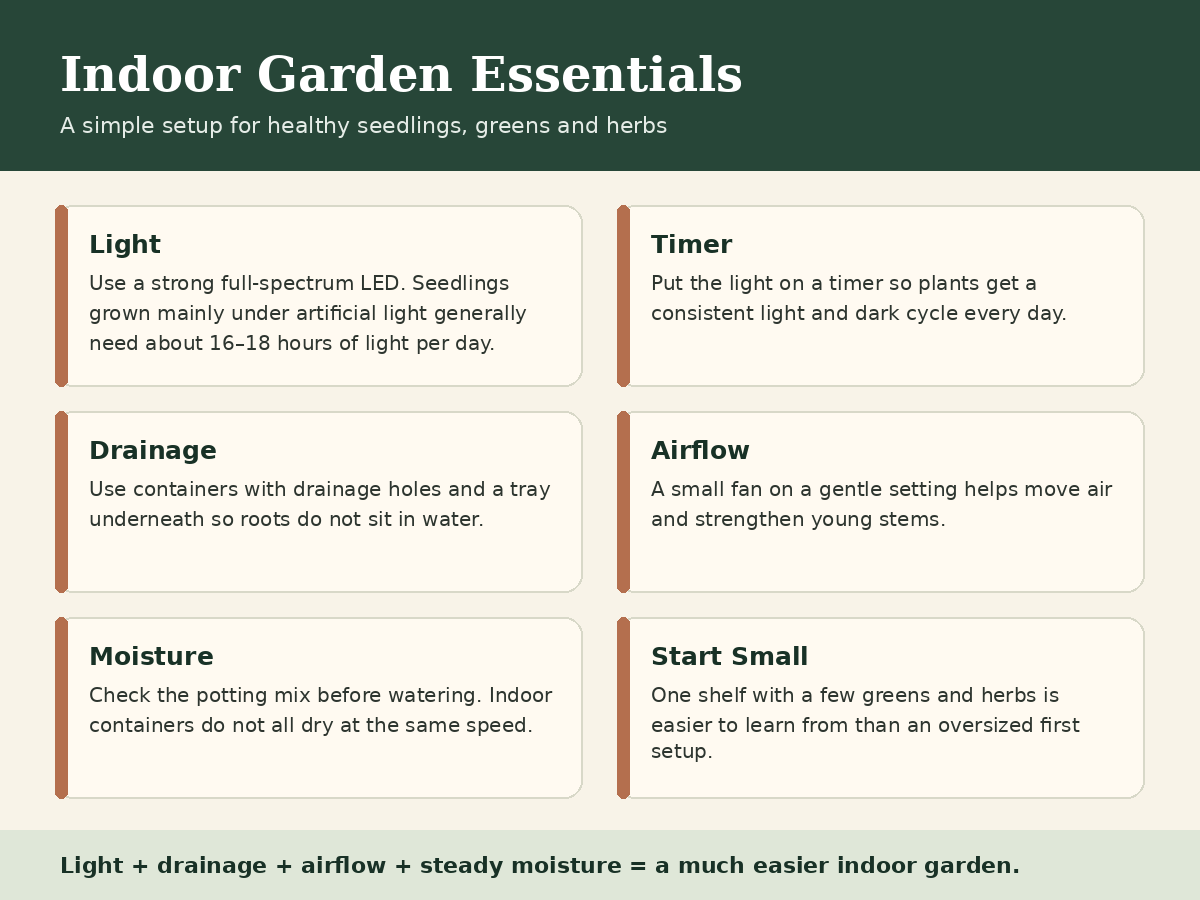
- A good full-spectrum LED grow light
- A timer
- Clean seed-starting or container mix
- Containers with drainage
- A tray to catch water
- Gentle airflow from a small fan
Choose crops by footprint, not just by whether they can grow indoors
Almost any vegetable can be grown indoors under sufficiently strong lights, but that does not make every crop practical. A head of lettuce can finish in a compact container, while a tomato may need a large pot, tall support, stronger lighting, more fertilizer, and months of space. Herbs, microgreens, leafy greens, compact peppers, and seedlings usually give the best return from a small indoor setup.
Containers need drainage and enough root volume
Indoor plants are completely dependent on the container you provide. Pots that are too small dry rapidly and restrict roots, while pots without drainage can stay saturated and create root problems. Use saucers or trays to protect floors and shelving, but do not let containers sit permanently in standing water. Fruiting crops require substantially more root volume than seedlings or lettuce.
Indoor plants still get pests
Aphids, fungus gnats, spider mites, and whiteflies can appear indoors even when plants never spend much time outside. Check new plants before placing them beside the rest of the setup and inspect leaf undersides regularly. Overwatering is one of the easiest ways to encourage fungus gnats. Catching a small pest population early is much easier than treating an entire shelf later.
Some crops need help with pollination
Tomatoes and peppers are self-fertile, but indoor plants may benefit from gentle vibration of flower clusters because there is no outdoor wind or normal insect activity. Cucumbers and squash can be more complicated because male and female flowers must exchange pollen. If your main goal is food production rather than experimentation, leafy crops avoid this problem entirely.
Fertilizer becomes more important in containers
Indoor plants cannot send roots into surrounding soil looking for nutrients. Seed-starting mix may contain little or no fertilizer, and repeated watering can move soluble nutrients out of containers. Once seedlings have true leaves or established crops begin active growth, use an appropriate complete fertilizer according to the product label. More is not better; salt buildup from overfeeding can damage roots just as surely as underfeeding can slow growth.
Keep one shelf simple before expanding
A single well-lit shelf can teach you most of what you need to know about indoor watering, airflow, pests, and crop choice. Get that system running smoothly before adding more shelves. Expansion is much easier when you already know the routine rather than scaling up a setup that still has basic problems.
Water by the plant, not the calendar
Indoor containers do not all dry at the same speed. Check the potting mix instead of deciding that everything needs water every third day. Water thoroughly when needed, let excess water drain, and avoid keeping roots permanently soggy.
Keep airflow gentle
A small fan helps prevent stagnant humidity and strengthens seedlings, but you only need slight leaf movement. The goal is air circulation, not a wind tunnel.
Fruiting crops need more
Tomatoes and peppers need stronger light, more root space, steady fertility, and sometimes help moving pollen. If you want actual indoor production rather than a plant that merely survives, choose compact or dwarf varieties.
Succession planting is where indoor growing shines
For lettuce, cilantro, bok choy, and other quick crops, start a small amount every week or two. That gives you a rolling harvest instead of one large flush followed by an empty shelf.
Reuse potting mix carefully
Healthy container mix can sometimes be refreshed and reused, but I would not reuse mix from trays that had damping-off or other disease problems. A casual backyard compost pile should not be assumed to sanitize diseased soil.