

Grow lights do not need to be complicated. Seedlings need enough daily light, the fixture needs to be the right distance from the canopy, and plants will usually show you when the setup is off.
How many hours of light?
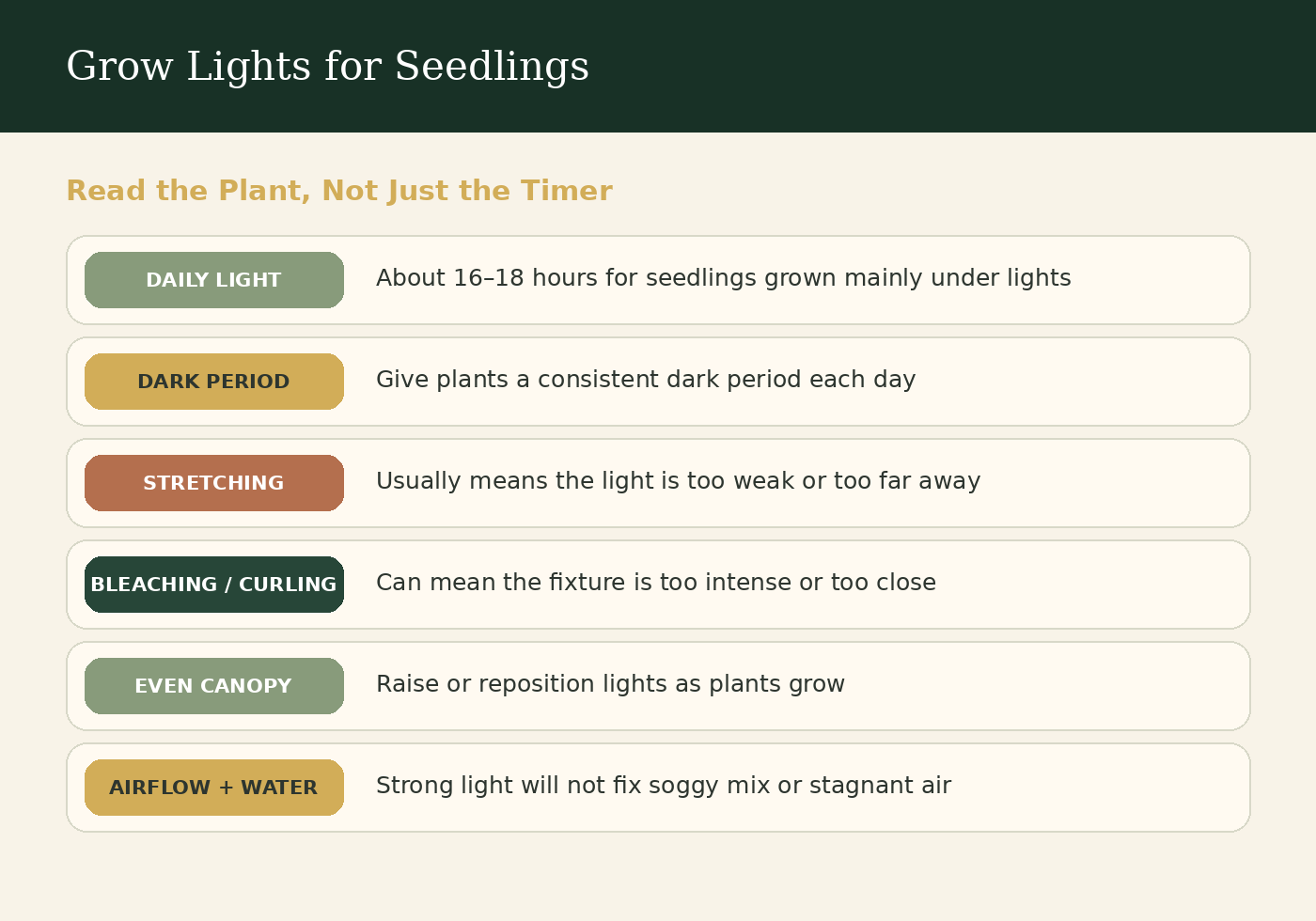
For seedlings grown primarily under artificial light, a practical target is generally about 16 to 18 hours of light per day, followed by a dark period. Leafy greens and herbs often do well with a somewhat shorter daily light period depending on fixture strength.
Light duration cannot make up for weak light
A timer is useful, but simply leaving a dim fixture on for more hours will not always produce sturdy seedlings. Stretching, thin stems, wide spacing between leaves, and seedlings leaning strongly toward the fixture are signs that the plants are not receiving enough usable light. Bring an adjustable fixture closer when appropriate or use a stronger light rather than expecting the timer alone to solve the problem.
Watch the canopy as plants grow
The correct distance between a fixture and the plants changes over time. Seedlings get taller, foliage becomes denser, and different shelves may grow at different rates. Raise the fixture or lower the plants as needed to keep the canopy reasonably even. Bleached patches, curled upper leaves, or unusually dry foliage directly beneath the fixture can indicate that the light is too intense or too close.
Airflow and watering still matter
Strong lighting does not compensate for saturated seed-starting mix or stagnant air. A small fan moving air gently across the growing area can strengthen stems and help surfaces dry more normally. Water when the mix actually needs it, not simply because the lights have been on all day. Trays without drainage can create root problems quickly, especially when temperatures are warm.
Fruiting crops need more than leafy greens
Lettuce and many herbs can perform well under a modest home setup because you are harvesting leaves. Tomatoes, peppers, cucumbers, and other fruiting plants demand stronger light, larger containers, more nutrition, and often hand pollination indoors. It is possible to grow them, but the equipment and space requirements rise quickly. For many gardeners, grow lights are most efficient when used for seedlings, herbs, and compact leafy crops.

How close should the light be?
There is no universal “four inches above the leaves” rule because LED fixtures vary enormously in output. Use the manufacturer’s recommended distance as the starting point and watch the plants.
Do vegetables need a 12/12 flowering schedule?
No. Tomatoes, peppers, lettuce, herbs, and ordinary garden vegetables do not need a cannabis-style 12-hours-on/12-hours-off schedule to flower or produce. A full-spectrum or balanced-white LED on a consistent timer is simpler for a home vegetable setup.
Raise the light as plants grow
Keep the fixture positioned so the entire canopy receives reasonably even light. As seedlings get taller, adjust the fixture rather than letting leaves grow into it.
Light is only one piece
Strong lighting will not fix saturated potting mix, poor airflow, overcrowding, or a lack of nutrients in older container plants. Indoor growing works best when light, water, air movement, root space, and fertility are all reasonably balanced.
Keep the system repeatable
The easiest indoor setup is one you can reproduce every season without guessing. Mark shelf heights, label timer settings, and note which fixtures produced sturdy seedlings. If one shelf consistently stretches plants or dries trays faster than the others, record that too. Small notes turn next year's seed starting into a repeatable process instead of another round of experimenting from scratch.
Clean lights and reflective surfaces matter
Dust on fixtures and dirty reflective surfaces reduce the amount of light reaching plants. Wipe fixtures when they are cool and unplugged, keep shelves clean, and rotate trays if one side consistently grows faster. Small maintenance steps can improve uniformity without buying another light.
Use the seedlings as your measuring tool
You do not need laboratory equipment to improve a home grow-light setup. Compare stem thickness, leaf color, spacing between leaves, and the direction plants lean. Those visible responses tell you whether the setup is working well enough. Make one adjustment at a time and watch the next several days of growth.